Partie 7 : La première chose dans la valise
Après les funérailles, nous étions tous les trois assis autour de la valise cabossée dans notre salon.
La pluie avait commencé à taper doucement contre les fenêtres.
J’ai détaché l’enveloppe d’Ezra de la poignée et l’ai ouverte.
À l’intérieur, il y avait une seule note.
Anthony,
Tu as passé douze ans à refuser quoi que ce soit de ma part. Pour une fois dans ta vie, arrête de te disputer et ouvre la valise.
Malgré tout, j’ai ri.
Rachel essuya ses larmes sur les joues.
« Ça lui ressemble. »
J’ai passé mon pouce sous le loquet plié.
Il s’ouvrit immédiatement.
Le second loquet résista.
Pendant plusieurs secondes, je me suis demandé si Ezra avait aussi arrangé cela, m’obligeant à lutter avant de comprendre ce qu’il avait fait.
Finalement, le loquet se relâcha avec un clic sec.
J’ai soulevé le couvercle.
Une légère odeur de cèdre, de papier et de vieux café flottait dans la pièce.
The first thing I saw was a photograph.
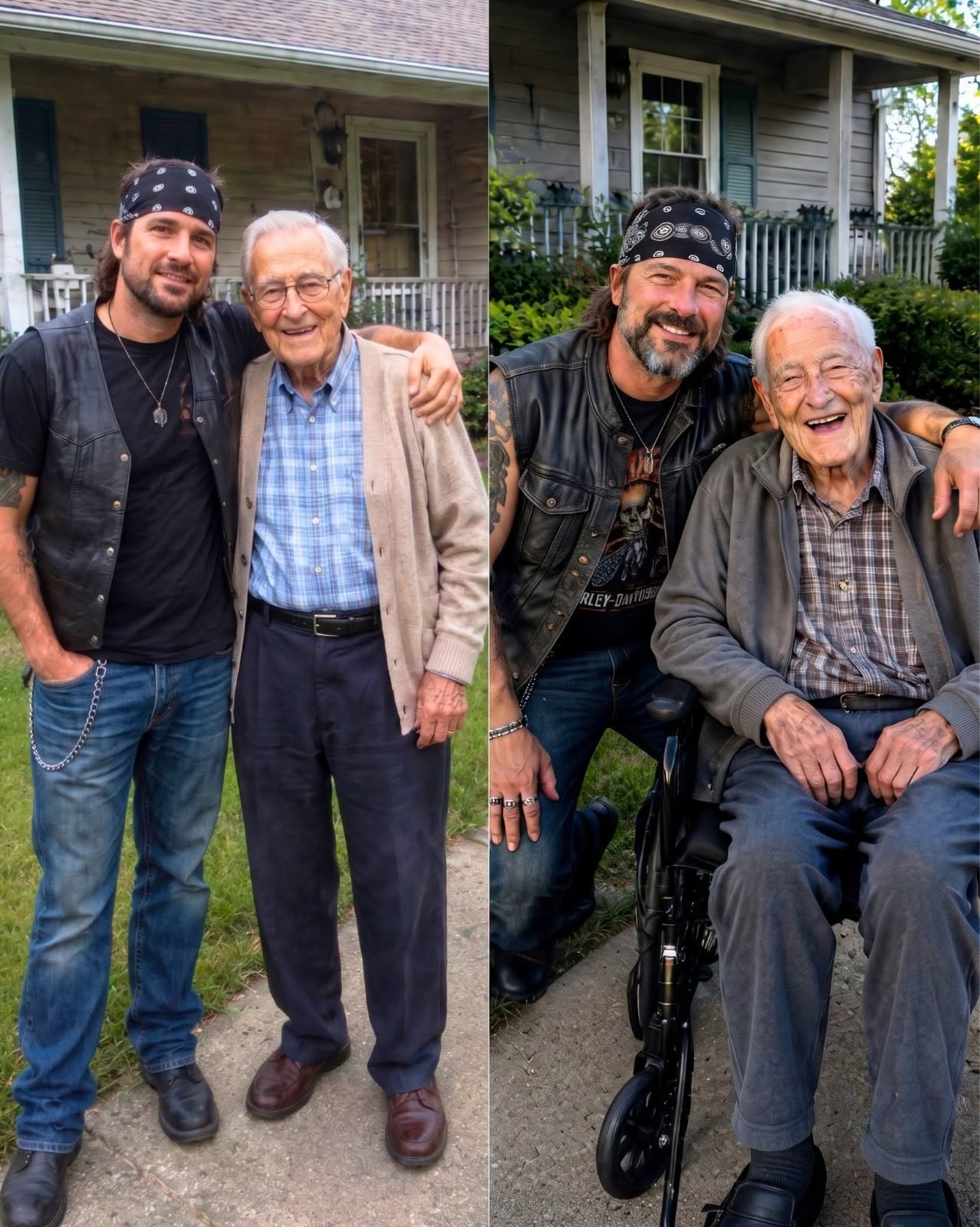
Ezra and I were standing on his porch. I was holding two grocery bags. He had one hand on my shoulder, and both of us were laughing.
I did not remember the picture being taken.
On the back, Ezra had written:
The first Sunday Anthony stayed for coffee. Neither of us understood how important it would become.
Beneath the photograph lay several blue notebooks.
There were twelve of them.
Each had a year written on the cover.
YEAR ONE.
YEAR TWO.
All the way through YEAR TWELVE.
I opened the first notebook.
The earliest entry was dated the day I had helped him carry in the spilled groceries.
Anthony Russo came into my house today. He pretended he stayed because of the coffee. I believe he noticed I was lonely, though I am not sure he understood it himself.
The next entry made me laugh.
Anthony refused repayment again. He is either generous or extremely stubborn. Most likely both.
We kept reading.
Ezra had written about almost every Sunday.
Not long entries—sometimes only a paragraph or two.
He recorded ordinary moments I had forgotten.
The day Emma first came to his house.
The day Rachel sent him banana bread.
The afternoon we argued about football.
The time I accidentally bought low-sodium soup and Ezra accused me of trying to remove all pleasure from his life.
Year after year, his handwriting preserved the smallest details.
In the seventh notebook, I found an entry that made my throat tighten.
Anthony called me his neighbor today. That is accurate, but incomplete. Somewhere along the way, he became the son life did not allow me to keep.
Ezra and Helen had once had a son named Daniel.
He had died as a young adult after a sudden illness.
Ezra rarely spoke about him. When he did, the grief in his voice remained quiet but unmistakable.
I closed the notebook.
For years, I had believed I was helping an elderly neighbor.
I had never understood the place he had given me in his heart.
But the notebooks were only the first layer.
Underneath them were hundreds of small white envelopes, each marked with a Sunday’s date.
Part 8: Every Dollar I Refused
The envelopes were tied together with faded string.
I opened the first one.
Inside was a grocery receipt and several folded bills.
The amount matched the total on the receipt.
I opened another.
The same thing.
Receipt. Money. Date.
Week after week.
Year after year.
Every time I had refused Ezra’s money, he had placed it in an envelope.
Some held forty dollars. Others held sixty or eighty. During the years when his health declined and I bought more supplies, the amounts were higher.
At the bottom of each envelope, he had written a brief note.
Anthony returned the money under the sugar bowl.
Found this in my truck two days later. He thinks he is clever.
Attempted to place cash in his jacket. Failed again.
Emma laughed through her tears.
“There are hundreds of these.”
There were 624.
At the bottom of the suitcase was a larger envelope with my name on it.
Inside, I found a bank statement.
At some point, Ezra had stopped keeping cash in the envelopes and had begun depositing the money into a separate savings account.
The balance was more than sixty-one thousand dollars.
My hands began to shake.
“This can’t be right,” I whispered.
Rachel reviewed the document.
“It has your name on it.”
“I didn’t earn this.”
“You paid for twelve years of groceries.”
“That wasn’t a loan.”
Before Rachel could answer, Emma reached into the suitcase.
“There’s something else.”
Beneath the bank documents was a thick legal folder.
Inside was the deed to Ezra’s house.
For several seconds, I could not understand what I was looking at.
Then I saw my name.
Ezra had left me the house.
There was also a letter marked:
READ LAST. THEN CALL MARTIN BEFORE YOU DO SOMETHING STUBBORN.
I opened it.
“Dear Anthony,
I know what you are thinking. You are thinking that you cannot accept the money or the house. You are probably preparing a speech about how you never helped me for a reward.
That is precisely why I trust you with both.”
I had to stop reading.
My vision blurred.
Rachel placed her hand over mine.
I continued.
“The money is not payment for groceries. A person cannot put a price on being remembered.
You gave me something far more valuable than food. Every Sunday, I knew someone would knock on my door. I knew there would be a voice in the kitchen, boots on the floor, and another cup beside mine.
After Helen died, the house became a place where I waited for the days to pass. After you and your family entered my life, it became a home again.
Use the money for Emma’s education, your business, or your family. Sell the house if that is best. Live in it someday. Rent it. I place no condition on the gift.
But if you are searching for an idea, remember this:
A house is not alive because someone owns it. It is alive because someone is expected there.
Keep the porch light on for someone who needs to know they are expected.
Your neighbor,
Ezra”
For a long time, the three of us sat in silence.
The rain continued outside.
Across the yard, Ezra’s porch remained dark.
For illustrative purposes only
Part 9: The Decision
The next morning, Rachel and I met with Martin Hale.
Ezra had predicted my reaction perfectly.
“I can’t accept the house,” I said before Martin finished explaining the will.
He leaned back in his chair.
“Mr. Harrison said those would probably be your first words.”
“The money should go to a charity.”
“He left a substantial portion of his estate to several charities, the public library, and a scholarship fund for trade-school students.”
“What about his relatives?”
“He had distant relatives. They received personal items, letters, and specific financial gifts. The house was deliberately left to you.”
“Why?”
“Because he trusted you.”
Martin explained that Ezra had lived simply after selling his company. The house had no mortgage, and he had created a separate fund to cover several years of taxes and basic maintenance.
I could keep it without taking money away from my family.
But for weeks, I still did not know what to do.
Selling the house would have been practical. Rachel and I could have paid off our mortgage. We could have covered Emma’s college expenses and invested the rest.
Keeping it would have made sense too. Emma might have lived there someday. Rachel and I could have moved into it when we grew older.
But every morning, I looked across the yard and saw the empty porch.
The house was not merely a piece of property.
It was the place where Ezra had waited for me every Sunday.
One evening, I walked inside alone.
Everything remained as he had left it.
The yellow clock ticked above the sink. Helen’s photograph stood beside the coffee maker. His mug was upside down on the drying rack.
I sat in his chair.
The silence felt heavier than the suitcase.
Then I noticed something on the refrigerator.
Ezra’s final grocery list was still attached with a magnet.
Eggs.
Bread.
Bananas.
Coffee.
Chicken broth.
Peach preserves.
At the bottom, he had added one sentence I had not noticed before:
Anthony will probably stay for coffee.
That was when I understood what the house needed to become.
Not a memorial where nothing could be touched.
Not an investment.
A place where people could expect someone to walk through the door.
Part 10: Ezra’s Sunday House
We named it Ezra’s Sunday House.
At first, the plan was modest.
We would create a neighborhood pantry for older residents and people who had difficulty shopping. Volunteers could deliver groceries, provide rides to appointments, perform small household repairs, or simply visit someone who lived alone.
Once the community heard the story, the idea grew.
A retired electrician offered to replace the wiring.
A contractor repaired the porch and widened the entrance. My employees built pantry shelves. Rachel organized volunteers. Emma created a website and helped us apply for nonprofit status.
Martin handled the legal paperwork without charging us.
We used part of Ezra’s grocery fund to renovate the kitchen and purchase a used delivery van.
We kept the yellow clock.
We kept Helen’s photograph beside the coffee maker.
We kept Ezra’s table, though we added more tables around it.
In the front room, we placed the battered suitcase inside a glass cabinet. Beside it hung the photograph of Ezra and me holding the grocery bags.
His private notebooks stayed with my family.
But we framed one sentence from his letter and hung it above the fireplace:
Keep the porch light on for someone who needs to know they are expected.
The first Sunday we opened, I was terrified no one would come.
By noon, every chair was occupied.
Mrs. Ellison arrived first. Her children lived across the country, and she usually ate alone.
Then came Mr. Grant, a retired mail carrier whose wife had moved into a long-term care facility.
Two college students volunteered to deliver groceries. Several teenagers offered to rake leaves, repair fences, and shovel snow during winter.
A young mother came for diapers and left with three new phone numbers from people who offered to help.
An elderly man sat by the window drinking coffee while a volunteer listened to stories about the hardware store he had once owned.
The house was noisy again.
Coffee cups clinked.
People laughed.
Someone turned on Ezra’s favorite jazz station.
For one brief moment, I imagined him sitting in his usual chair, silently inspecting everything.
Emma came to stand beside me.
“He would love this,” she whispered.
“He would complain about the coffee.”
“Absolutely.”
“And the porch railing.”
“He would say it leans.”
“It does lean.”
She looked at me.
“Dad, it’s perfectly straight.”
I laughed so suddenly that tears filled my eyes.
Part 11: Every Sunday After
Three years have passed since Ezra died.
Ezra’s Sunday House now helps more than eighty people throughout our county.
Some need groceries.
Some need transportation.
Some need a porch step repaired, a lawn mowed, or a lightbulb replaced.
Others need nothing except a warm drink and another person willing to listen.
Every Sunday morning, I still go shopping.
The list is much longer now.
I buy bread, milk, fruit, oatmeal, coffee, soup, vegetables, and whatever else the volunteers have requested.
I always add a jar of peach preserves, even when it is not on the list.
Ensuite, je conduis jusqu’à la maison d’à côté.
La lumière du porche est déjà allumée.
Parfois, je reste dehors un moment avec des sacs de courses dans les bras.
Je regarde l’allée bondée, la rampe réparée, et les vitres avant qui brillent de chaleur.
Les gens me disent souvent que j’ai changé la vie d’Ezra.
Peut-être que oui.
Mais ils ne comprennent pas à quel point il a complètement changé les miens.
Pendant douze ans, j’ai cru faire quelque chose de petit.
Je pensais ne faire les courses que pour un voisin âgé qui ne pouvait plus conduire.
Je ne réalisais pas que je donnais à quelqu’un une raison d’attendre avec impatience le dimanche.
Je ne réalisais pas que ces tasses de café m’apprenaient à écouter.
Je ne réalisais pas que les après-midis ordinaires auxquels je pensais à peine deviendraient certains des moments les plus importants de nos vies à tous les deux.
Et je ne savais certainement pas qu’Ezra conservait chaque reçu, enregistrait chaque souvenir, et préparait discrètement un dernier cadeau qui rassemblerait toute une communauté.
La valise n’était pas vraiment un héritage.
C’était la preuve.
La preuve que la gentillesse ne disparaît pas simplement parce que personne ne l’applaudit.
La preuve qu’une routine ordinaire peut devenir la bouée de sauvetage de quelqu’un.
La preuve que la présence est parfois le plus beau cadeau qu’une personne puisse offrir à une autre.
Ezra me manque toujours.
Ses plaintes, ses blagues sèches, sa fierté obstinée, et la façon dont il voyait à travers toutes mes excuses, me manquent.
Il y a des matins où je m’attends encore à trouver une de ses listes de courses glissée sous mon essuie-glace.
Mais le deuil a changé.
On ne ressemble plus à une porte verrouillée.
On dirait une lumière de porche.
Un rappel que quelqu’un m’a attendu autrefois.
Et maintenant, grâce à Ezra, des dizaines de personnes savent que quelqu’un les attend aussi.
Note : Cette histoire est une œuvre de fiction inspirée d’événements réels. Les noms, personnages et détails ont été modifiés. Toute ressemblance est une coïncidence. L’auteur et l’éditeur renoncent à l’exactitude, à la responsabilité et à la responsabilité des interprétations ou de la confiance. Toutes les images sont uniquement à titre d’illustration.